Saturday, September 29, 2007

Dr. Sketchy: Booze, Babe & Burlesque


Cabaret meets Art School

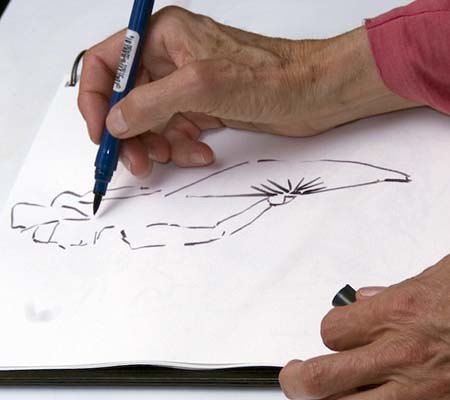
CoCA artists had the pleasure of welcoming the Dr. Sketchy Troupe http://www.drsketchyseattle.com/ yesterday to Cabana night at Shileshole to host their most ribald event of the season. Babette La Fave (also of “The Atomic Bombshells” Burlesque performance group) http://www.theatomicbombshells.net/ posed throughout the evening for an audience of 53 skilled artists armed with sketch pads, drawing pencils, watercolors, easels and paintbrushes and ready to capture her fanciful, colorful outfits and provocative poses.

Making sure we knew how many minutes the poses would be held for was the Master of Ceremonies, “Ernie Von Schmaltz”. Ernie called out the poses, entertained the audience with jokes and conducted the prize contests.

Babette opened the show adorned with a pink head-dress, diamond-like necklace, and white with pink striped corset with pink feathers strung around the sides of her waist. Her striking blond hair and bright read lipstick finished the effect while “Ernie” called out how long the pose would be held so artists would know how fast to draw.

Although there was plenty of beer and wine available to stir the creative juices, most of the artists were focused on the opportunity to draw Babette who held perfectly still in various poses and costumes throughout the evening.

Over 60 guests and members watched what has become a popular event in 38 cities around the world. Originating in New York City but landing in Seattle in May of this year, Liz Panelo, “Headmistress” of Dr. Sketchy Seattle attributes the explosive growth of the format to the “Anti-Art School” no rules format, basically artists just have fun. What’s the secret? She hires unusual models: beautiful burlesque models and bizarre circus performers all dressed in ribald outfits. For $10 bucks admission it’s the best show in town.

Dr. Sketchy holds sessions on the 3rd Monday each month normally holding meetings at the Rendezvous Theater http://www.jewelboxtheater.com/main/Who normally attends? “Architects, Housewives, Graphic Artists”, Liz says. "Essentially, it’s open to anyone who wants to draw."

James Greer was the first among several contest winners and won a gift certificate. Will CoCA decide to hold this event again? Several of the artists felt it was a more suitable space for the group because there was better lighting and more room for easels and sketchbooks. We'll see what happens.

Want more photos? Check out CoCA's photo's of the events!

http://www.flickr.com/photos/cocaseattle/sets/72157602191644763/

Sunday, September 16, 2007

The Koi are eating my thought bubbles......

Who says nothing good ever comes from a posting on Craigslist? In fact, I met the Painter John Osgood this way. John answered my Craigslist ad seeking a Painter to model for me for a photo shoot. We finally agreed to meet at his studio this Saturday. John and fellow painter, Andre Martin are exhibiting at Bherd Studios. I love John's work and think he would make a great addition to the Painting Marathon this year. I think there still are a few spots available, but they are filling fast.

I floated the idea to them of having the Painting Marathon in Pioneer Square on a first Thursday sometime-- everyone agreed it would be an amazing event. Although it's not possible to arrange for this year, 2008 is a strong possibility, so stay tuned.

Best of luck with your show, John--maybe I'll see you at the Marathon this year. I suggest you swing by to check out the exhibit: Bheard Studios is located at at 315 NW 85th Street in the Greenwood area of Seattle.


Saturday, September 15, 2007

Interview with Thomas Robey, Participant in the "Inquiry as Collection" Show


Interviewer Question: So I understand the 3 pieces of work you submitted to the: “Inquiry as Collection: Wundercabinets, Collage, Assemblage” show was inspired by an assignment from teacher David Francis of the Pratt Fine Arts Center? What were the rules or instructions for creating your pieces?

Thomas Robey: The course at the Pratt Fine Arts Center was not so much centered on a curriculum with assignments; it was an intense workshop in which each artist could feed off the energy and perspective of the other participants. The three consecutive days offered a context for me to explore an artistic medium that I related to the historical phenomena of Wundercabinets. David Francis facilitated my understanding of the current approach to cabinet assemblage, and how I could integrate some of my other interests into my pieces.

Interviewer Question: Your displays had a magnifying glass and also a list of descriptions—why did you include them in your submission?

Thomas Robey: My pieces rely on assembling a large number of small items. Their arrangement is meaningful to me, but could take on other interpretations for other people. My hope, especially for the assemblage of rodent parts http://hope-for-pandora.blogspot.com/2007/08/opening.html (“Gratiaedonatus oriens”) is that the viewer is first curious about all of the items; the magnifying glass permits close examination. I wanted to provide the interested viewer with information that could help them move their inquiry to another level. Instead of labeling that piece, I opted to make a key.

I tried to facilitate interaction with the other pieces as well. In http://hope-for-pandora.blogspot.com/2007/08/8005-spw-ne.html 8005 Sand Point Way NE, each glass microscope slide can be removed for closer inspection. They are each numbered so that they can be easily restored to fit within the scala naturae hierarchy. My third piece http://hope-for-pandora.blogspot.com/2007/08/seattle-colors.html “Seattle Colors” is interactive because the individual berries have the possibility of rotting or degrading over time. The artist/curator must restore the berries to fit with the rainbow color scheme as different source berries are available with the season.

Interviewer Question: Since your task was partly to create an assemblage, aside from collecting things, how does your project reflect your personality? What is different about your project compared to those from other students?

Thomas Robey: I am a scientist. Not only that, but my research uses mouse models of heart disease to study heart attacks. As such, I am very familiar with rodent anatomy. Dissecting owl pellets for http://hope-for-pandora.blogspot.com/2007/08/opening.htmlGratiaedonatus oriensoffered an opportunity to explore a different way of working with mice. My familiarity with rodents also offers the foundations of a bridge I hoped to build to connect science with a non-scientist observer.

Interviewer Question: Does your art have a dominant message behind it at all? Are you trying to say something about the world or yourself?

Thomas Robey: My intent in creating these pieces was to try and raise awareness of nature in the context of an urban environment. Whether it is rodents, local berries or items found in the vicinity of a given address, there is an element of wonder that urban-dwellers may experience when presented with an assemblage of strange-looking items. The irony is that these items are just under our noses. Creating these wonder cabinets is a way for me to connect with my context.

Interviewer Question: Have you worked in this format before? If so/not, what do you see as its strengths or weaknesses?

Thomas Robey: I have curated collections of rocks, fossils and found natural items since I was a boy. This is the first time I have worked with assemblage or attempted to present the items in a way that also offered a message.

Interviewer Question: Since you are not a full time artist, how did you feel about participating in the show?

Thomas Robey: I appreciate that David Francis offered the opportunity to participate in this group show. Contributing to Inquiry as Collection is an honor for me and has introduced me a little bit to how art shows are planned and presented. More importantly, presenting at COCA has also introduced me to a new community – one that might offer an avenue to better connect art and science.

Interviewer Question: What sorts of comments did you get about your entries?

Thomas Robey: I was pleased to see that folks were using the magnifying glass to inspect the items and the identification keys.

Interviewer Question: Are you going to continue creating art? If so, in what genre?

Thomas Robey: I really like assemblage and the concept of the wonder cabinet. I have a lot of ideas about how my training as a scientist can inform novel expressions of creativity. My schooling will require me to move quite a bit in the coming year, and I plan to make an address themed cabinet for each location where I live: Anacortes, Spokane and Fairbanks.

As an aside, I want science outreach to be an important part of my career. I think that the intersection of science and art can be a rewarding area in which to explore new ways to highlight science’s role in society.

Thomas Robey pursues many approaches to elevate awareness of science in society. He writes about these ideas at his blog, Hope for Pandora. http://hope-for-pandora.blogspot.com


Friday, September 14, 2007

Late night offerings in Georgetown

I finally got to see inside the Belltown Gallery space last Friday during the artist reception for John Schun. It’s a very unusual space to say the least. John’s work is perfect for that space. I’ve posted some pics from the reception on our new Flickr site. Hopefully the photos will help you appreciate that the Belltown Gallery is a twilight light gallery, it’s best viewed after dark.

Sorry, there’s not that many pics up on the Flickr site just yet but stay tuned, CoCA has events planned for each month for the rest of the 2007. Plenty of opportunity for taking more photos. Rumor has it we’ll be hosting a Halloween party.
Photo:Belltown Curator, Ray Freeman


The Georgetown Arts Center

After the artists reception Brian and I headed south to check out the Georgetown Art Center. It’s a great space, a former dance hall complete with kitchen & bar. We ran into Angielena Chamberlain, director of the Georgetown Art Center. She’s a great host not to mention talented artist. There are studio spaces still available if you’re interested. The Georgetown Art Center is located at 5511 ½ Airport Way S, right above Stellar Pizza (206) 851-1538

Thursday, September 13, 2007

Interview Questions for David Francis, Curator, "Inquiry as Collection" Exhibit


Interviewer Question: Mr. Francis, as Curator for the: “Inquiry as Collection: Wonder Cabinets, Collage, Assemblage” show, what was your purpose in assigning this project to your students at the Pratt Fine Arts Center?

David Francis: The show wasn’t “assigned” as a project. It wasn’t a formal part of the workshop at Pratt, except that toward the end, after about 20 hours of intensive time in the studio working with specimens and boxes and collaborating intensely with the class, it occurred to me that the work we had produced reflected a fascinating array of backgrounds and approaches and that we had the beginnings of a show right then and there and that, owing mostly to timing and coincidence, I was in a position as a board member and curator at CoCA to make that happen on fairly short notice.

On a general level, the purpose behind linking my Pratt class “Assembling the Modern Wonder-Cabinet” (currently offered Oct. 12 – 14, 2007 and March 7,8,9 2008; www.pratt.org) to a show at CoCA is to bring different arts organizations together for what I hope will be the first in a longer series of collaborations and projects. When I curated “Shard” for CoCA in early 2006, my purpose was similar in that I tried to bring artists from Cornish (students as well as colleagues) into direct association with CoCA.


Interviewer Question: What were the rules or instructions the students have to follow?

David Francis: Main activity: Starting to create objects and review strategies for display & assemblage. (What categories or taxonomies will the cabinet organize? In what sequence will they be displayed? etc.) Consider hybrid objects like Nick Bantock makes – a dried fish head attached to a toy wheel, etc. (By day’s end, students should have created at least three objects for the cabinet and have a preliminary sense of the desired size and organizational strategy.)

For Session 2, students should bring in the materials for construction of the cabinet itself, whether a simple cigar box, a converted dresser drawer, or larger fabrication. The cabinets need not be finished for session 2, but the boards and / or nails, etc. should be obtained for bringing to the workshop. ALSO: bring in pedestals and display boxes, glass jars and rubbing alcohol, “wet specimens,” collections of objects for exchange, antique books…varnish for finishing box or paint or wallpaper, old newspaper for shelf background…Review aesthetic principles of combining art objects with science specimens – wonder cabinets were being made before these disciplines had become separate. Considering adding “classic” or “typical” elements such as horns, fossils, mummified specimens, skulls, “soft tissue” specimens in jars, prehistoric artifacts, miniature works of art, etc. Cabinet hierarchy: since cabinets are representations of the known world in miniature, consider sectioning the space into such categories as animal / vegetable / mineral / God (also called a scala naturae).

Interviewer Question: Is this an assignment you give every year? Have the types of projects the students produce changed much over the years? Is this influenced by politics or culture or some other factor?

David Francis: I’ve been teaching versions of this assignment at Cornish for a few years, but haven’t noticed much change of the kind you describe. Gauging student interest in a project, especially for a required humanities class, and attributing it to a cultural phenomenon might require a larger sample population. Nevertheless it’s interesting to speculate about why Wonder Cabinets now?, i.e., why is there a resurgence of interest in this at this moment in history? Aside from Lawrence Weschler’s great book Mr. Wilson’s Cabinet of Wonder, which nearly won the Pulitzer for non-fiction in the mid 90s, I’d speculate that it has something to do with all the attention devoted to the disciplines, to “interdisciplinarity” as it’s occasionally termed, as well as the globalization phenomenon that echoes the sudden expansion of the world some 400 – 500 years ago (at least in the West).

Interviewer Question: Were you surprised, either pleasantly or unpleasantly, by any of the projects your students submitted?

David Francis: I became more and more inspired by their work and the collaborative nature of swapping specimens & exchanging ideas.

Interviewer Question: In the context of “Art” or “Inquiry as Collection” how exactly do you feel your assignment develops the student’s artistic talent?

David Francis: Well, an emerging artist can have all the talent in the world and still toil in obscurity. I guess I implicitly urge working with other artists, in a community or a workshop setting, developing talent in terms of an experimental approach, a not-too-serious engagement that remains grounded in questioning and exploring – that’s why the word “inquiry” is important, but not so much of a purely “scientific inquiry” as an inquiry of the imagination, a poetics…and if someone can learn to develop that kind of – I guess “attitude” might be another synonym – they’ll be sure to make art a lifelong endeavor. The often-invoked pedagogical cliché that “it’s about the process, not the product” is worthy of frequent repetition, especially when artists make what they feel are “failed” pieces.

Interviewer Question: Would this be considered a “beginners” art project, or is the role of collection more interesting than that?

David Francis: The same critique is often used to disparage collage as a second-class kind of art or beginner’s medium--where collage is an art form for people who “can’t paint.” A brief glance at contemporary art, a single visit to the Henry or the Frye or SAM will make it manifestly clear how important collecting is to art of all kinds, not just from a socio-political perspective about how and when various works of art become commodities to be collected and owned, but from an ahistorical, nuts & bolts perspective, a praxis that while learned early on in the education of an artist, never ceases to provide a resource –to use the show as an example, almost every artist can be seen to be a collector, often in a quasi-scientific way as if to comment on that dominant mode of assembling items: each box with its collection of “found objects” suggests endless narrative possibilities, little stories from which countless meanings can be spun. From Thomas Robey’s boxes with their dismantled rodent bones taken from owl pellets, to Wonderly’s classic hoard of doll heads, Lin’s tiny replica of buried strata, Reid’s “please touch” mini-museum of turning raccoon skulls, Henderson’s blend of architectural elements and nature, Livingston’s rows of fossil corals, the work from the Pratt class is embedded in combinations of “scientific objects” with “art objects,” much as Wunderkammern offered an interdisciplinary prospective on knowledge.

David Francis is Curator of the “Inquiry as Collection: Wonder Cabinets, Collage, Assemblage” show from August 26-September 27, 2007

Tuesday, September 11, 2007

15th Annual Painting Marathon & Auction: November 8th, 9th, 2007


Marathon and Auction at:
The Place: Shileshole Bay Beach Club
Address: 6513 Seaview Ave NW, Seattle, WA 98107

  • Painting Marathon: Begins Thursday, November 8th, at 9 am and goes through Friday, November 9th, at 9 am (24 hours). Admission is Free.
  • Auction: Begins Friday November 9th, at 6 pm. There will be 2 Silent Auctions and 2 Live Auctions.
  • Tickets: buy them for the auctions at brownpapertickets.com
  • Prices: $20.00, General Admission Seat; $50.00 VIP Admission includes table seating, wine, hors d' oeuvres and a CoCA membership! $500.00 VIP Admission includes reservation of a full Table (seats 10 people).
There are 10 open spots at this time and the 2007 CoCA Painting Marathon Selection Committee wants to encourage artists to participate. The deadline for submissions is October 10th. E-mail the committee to indicate your interest at submissions@cocaseattle.org and we'll send you an application form.

Questions? You can reach us by e-mail at submissions@cocaseattle.org or phone us at 206-728-1980

We also need volunteers for both the Marathon and the Auction. Please inquire at: info@cocaseattle.org or please phone. Volunteers are rewarded with a 1 year CoCA membership and free admission to the Marathon.


Monday, September 10, 2007

Did the Artist who put this together get an A?


For some reason, I can't get the name "Chucky" out of my head, after I saw this one. Just another one of the attractions you will find at Shileshole through the 27th. Doesn't it feel like the name for this should be in French, or something like that?

“Inquiry as Collection: Wonder Cabinets, Collage, Assemblage” show from August 26-September 27, 2007


If you haven't already, you should not miss the “Inquiry as Collection: Wonder Cabinets, Collage, Assemblage” show from August 26-September 27, 2007. It is curated by David Francis of the Pratt Fine Arts Center and features work from several of his students.

Artists:
Scott Ezell
David Francis*
Mary Ann Henderson
Jill Levine
I-Pei Lin*
Clare Livingston*
Jodi Reid*
Thomas Robey*
John Schuh
Seb
Nan Wonderly*

2 artists wishing to remain anonymous

(If you do stop by, maybe when you get back you can help me out: tell me, are those assembled planks in the bottom picture supposed to be a a sunrise or a sunset? )

Interview with John Schuh, CoCA Premier, Belltown Show 9/7/07


John, let me first tell you how much I enjoyed your show in Belltown last night. I heard comments which ranged from “This is fucking amazing” to “Is this something you can’t help?", which of course got a few laughs. What you’ve done is put together some images which are quite transfixing, even hypnotizing. Your fractal photo collages are especially impressive when you notice after first viewing them at a distance that the elements used to compose the larger image is composed of the same type of smaller image. So let me ask you some questions about your work:

Interviewer Question: The idea for fractals is normally associated with mathematics. What gave you the inspiration to utilize it with art/photography? (I am thinking here of the painter in the short story you talked about at the opening.)

John Schuh: The fractal analogy was suggested by Ray Freeman, the curator of the CoCA Belltown Gallery. I think it's a helpful and compelling way to explain the work to people who haven't seen it in person. My original inspiration came from this passage from a short story by Jorge Luis Borge called "The Zahir": " . . . the governor showed him a cell whose floor, walls and vaulted ceiling were covered by a drawing . . . of an infinite tiger. It was a tiger composed of many tigers, in the most dizzying of ways; it was crisscrossed with tigers, striped with tigers, and contained seas and Himalayas and armies that resembled other tigers."

Interviewer Question: You had a phrase you used in your talk last night at the opening; you didn’t call it a fractal but instead . . . ? Does this phrase/word describe your concept better?

John Schuh: "Self-similar"? I'm not sure which phrase you're remembering. It was probably something off the top of my head. I usually describe my work by talking about the individual pieces. I tell people that I made a collage of a car out of photos of cars, a flower out of flowers, etc. But people often say they didn't really understand what I meant until they saw the work in person.

Interviewer Question: How do you decide what you want to photograph?

John Schuh: Once I've decided to work with a particular subject, the motivation for the photography is to create the widest possible variety of images of that subject. For
example, when I decided to do The Flower, I photographed flowers over the course of an entire year so I could capture all the types that bloom during the different seasons. As for choosing subjects, I simply photograph what I find interesting. I grew up in Madison, Wisconsin, which is a great city, but it doesn't have a skyline of tall office buildings like Seattle. So even though I've lived in Seattle for 12 years, I still get a thrill looking at the tall buildings. I've always enjoyed attending sporting events, so it was a natural progression for me to start photographing them and use them in a piece like Ring Of Honor. Subjects like flowers, water and seascapes are universal and timeless. Cars, on the other hand, are interesting because their appearance evolves from year to year.

Interviewer Question: Do you compose photos with a plan or end in mind? In other words,when you go out to take photos do you wait for inspiration to hit or do you have more specific goals?

John Schuh: I don't necessarily wait for inspiration to hit. The goal is generally to create material for the collages, so I approach the photography from the standpoint of technical execution. For instance, I'll go to a classic car show and just start photographing the cars. I'm thinking about the composition of the shot and getting the image in sharp focus, but I'm
not worrying about whether each picture will stand on its own as a great photograph. Of course, some of the photos turn out to be beautiful works of art in their own right, and I always try to
incorporate the best material into the collages if possible. In the end though, the photo has to serve the collage, and sometimes I have to leave great photos out because they just don't fit into the larger context of the piece.

Interviewer Question:
Which piece was the first one you put together? What were the “problems” or “challenges” you had with this first one?

John Schuh: My first collage was a human face based on a photo of the jazz singer Betty Carter. The important lesson I learned from that piece was the importance of contrast. If the images that go into a collage are too similar in shade and tone, the viewer won't be able to distinguish the larger image that the material is composing. You need lighter and darker images to represent light and shadow, which helps the viewer to imagine the image in three dimensions. With the Betty Carter piece, I went back and exaggerated the shadows around her mouth and nose to make those features pop out more clearly.


Interviewer Question: Do you have formal art training or education? If so, where did you study?

John Schuh: I have no formal art training or education. I guess that's why I needed to learn the above lesson about light and shadow at age 28! I'm 39 now, by the way.

Interviewer Question:
I notice that most of your photos use “industrial” elements, with just the stadium collage including people. Is there a message in your selection of topics? Do you feel your chosen topics match up better with your specific technique than other images, say from nature,etc.?

John Schuh: People find a lot of messages in my work, which I am always interested to hear about. It doesn't matter whether I intended the message or not. The CoCA Belltown show features my urban work, but I have used natural subjects also, such as flowers, beaches, clouds and water. The urban subjects like cars and buildings provide a lot of strong, straight lines which can be used in a visually striking way,whereas the natural subjects provide a lot of color. My urban work reflects the time and place in which I am working.

Interviewer Question:
Do you start with photos? If so, are you using film? Or are these created with digital images using Photoshop?

John Schuh: All of the collages I have exhibited to date are composed of film prints. I have started using a digital camera to take photos to use as collage material in the future, but I still plan on printing the photos and assembling the collages from prints.

Interviewer Question:
What steps do you take to create your collages? What is your process?

John Schuh: The process begins with photography. For some pieces, I try to photograph a wide variety of examples of a particular subject,such as flowers or cars. For other work, I photograph a single subject from a wide variety of angles. For example, the background
of The Flag is composed of about 150 photos of the downtown Seattle Public Library. The next step is to determine the overall design of the collage. For The Car, I used a single photo as a template for the entire piece. I usually make a pencil drawing and lay the collage material over it. For Italian Car Show, I made a detailed drawing of a Ferrari parked on a pier in front of the Seattle skyline. On the other hand, for Office Building I only drew a single large circle and improvised all of the other elements of the piece. I use a glue called Mod Podge to glue the prints onto the collage, then put another layer of the same glue over the top of the entire piece to complete the process. I sometimes use paintbrushes to create patterns in the top layer of glue. In fact, some people have thought on first glance that my collages were actually paintings.

Interviewer Question:
What is the main idea or feeling you want the public to take away
after viewing your pictures?

John Schuh: I simply want people to enjoy the experience of viewing my work. It's a thrill for me if someone says that they've never seen anything quite like it before.

Interviewer Question
Where will you be showing your collages next?

John Schuh: I don't have any future exhibitions scheduled at the moment, but I plan on continuing to show the work.

Interviewer Question:
Do you have a website where people can get more information?
www.JohnSchuh.net

Introduction to Center on Contemporary Art Blog


Artists!

“There are no rules! But if there are, the artist’s job is to break them!”
Joseph Roberts, CoCA President

Welcome to the Center on Contemporary Arts (CoCA) blog. We are based in Seattle and will be bringing you information about our programs, including: art exhibits, gallery showings, interviews, reviews, events, parties, meetings, sponsorship funding, government grants, prizes/recognition, photos, and other news and opinions about the art scene--or in other words, pretty much, everything relevant to CoCA and it’s members interests and those of the art appreciating community at large.

Can you imagine living without art? Every wall would be painted gray, every person would dress in the same style of clothing and every car driven down the road would be painted black. Who wants to live that way? Not us! Contemporary Art is the living vibrant soul of the community, providing fresh and novel ways to look at and experience the world and community around us. It’s an outlet for how we feel about what is going on around us and it’s also a reflection about whether we think it’s good, bad, or indifferent. Or not.